Use STA to Focus on the Last Two Positions
This page searches 44 five-letter reference entries beginning with STA. Once those first three positions are confirmed, the final pair carries the useful distinction. Keep that confirmed opening separate from a guess based only on letters you have seen elsewhere.
For instance, STAGE, STAKE, STALE, STARE and STATE differ in meaning despite sharing four of their five positions. Rather than repeatedly browsing the entire list, use an ending or adjacent sequence to test the evidence you actually have.
Investigate an E Ending Before Choosing STATE
Enter E in Ends with and select Find Words. The current collection returns STADE, STAGE, STAKE, STALE, STANE, STARE, STATE and STAVE. An E crossing alone does not establish which of those eight answers fits.
Add AT in Contains to leave STATE. Within this list, it is the only E-ending entry containing that adjacent pair. Check whether your clue asks for a condition, a territory or an act of expressing something; matching the filter does not select the intended sense.
Let an Ending Distinguish Related-Looking Forms
With other fields empty, ending T leaves START. Ending K instead produces STACK, STALK, STANK, STARK and STAUK. These examples show how the final crossing reduces the reference, while also showing why dictionary acceptance must be checked for unfamiliar entries.
Separate Repeated Letters from Adjacent Sequences
STAFF repeats F in its final two positions. Contains FF isolates STAFF in this collection because the copies are adjacent. STATE also repeats a letter—T—but its two Ts are separated. Contains TT therefore does not describe STATE.
The fields cannot express “at least two Ts anywhere” or a yellow letter forbidden from one position. Use the Wordle Solver for full colored rows and repeated-letter feedback, or the Wordle Finder when specific positions are known.
Keep Literal Text Out of Positional Notation
Starts with STA__ does not mean STA followed by two unknown squares. These fields trim outer spaces and uppercase text, but keep internal spaces and punctuation as literal characters. They do not recognize wildcard patterns or rearrange letters.
Read the STA Collection as a Reference, Not a Certified Lexicon
These are all 44 entries used by this page's filter. The list includes familiar words alongside name-like and uncommon forms. Its scope is the site's embedded collection, not every possible spelling or an official game's answer pool.
- STAAB
- STABS
- STACC
- STACK
- STACY
- STADE
- STAFF
- STAGE
- STAGS
- STAGY
- STAIA
- STAID
- STAIG
- STAIL
- STAIN
- STAIO
- STAIR
- STAKE
- STALE
- STALK
- STALL
- STAMP
- STAND
- STANE
- STANG
- STANK
- STAPH
- STARE
- STARK
- STARN
- STARR
- STARS
- START
- STARW
- STARY
- STASH
- STATE
- STATS
- STAUK
- STAUN
- STAUP
- STAVE
- STAWN
- STAYS
Do not infer that an unfamiliar entry is a valid competitive play just because it appears here. Check its definition and the dictionary edition required by your game. The structure and behavior checks below do not certify every entry's lexical status.
Use Familiar Spellings for a Focused Practice Exercise
Take STAGE, STAIR, STAMP and STATE and identify the last two letters before comparing meanings. Each keeps the same STA opening, so the exercise directs attention to the evidence that changes rather than rereading the shared prefix.
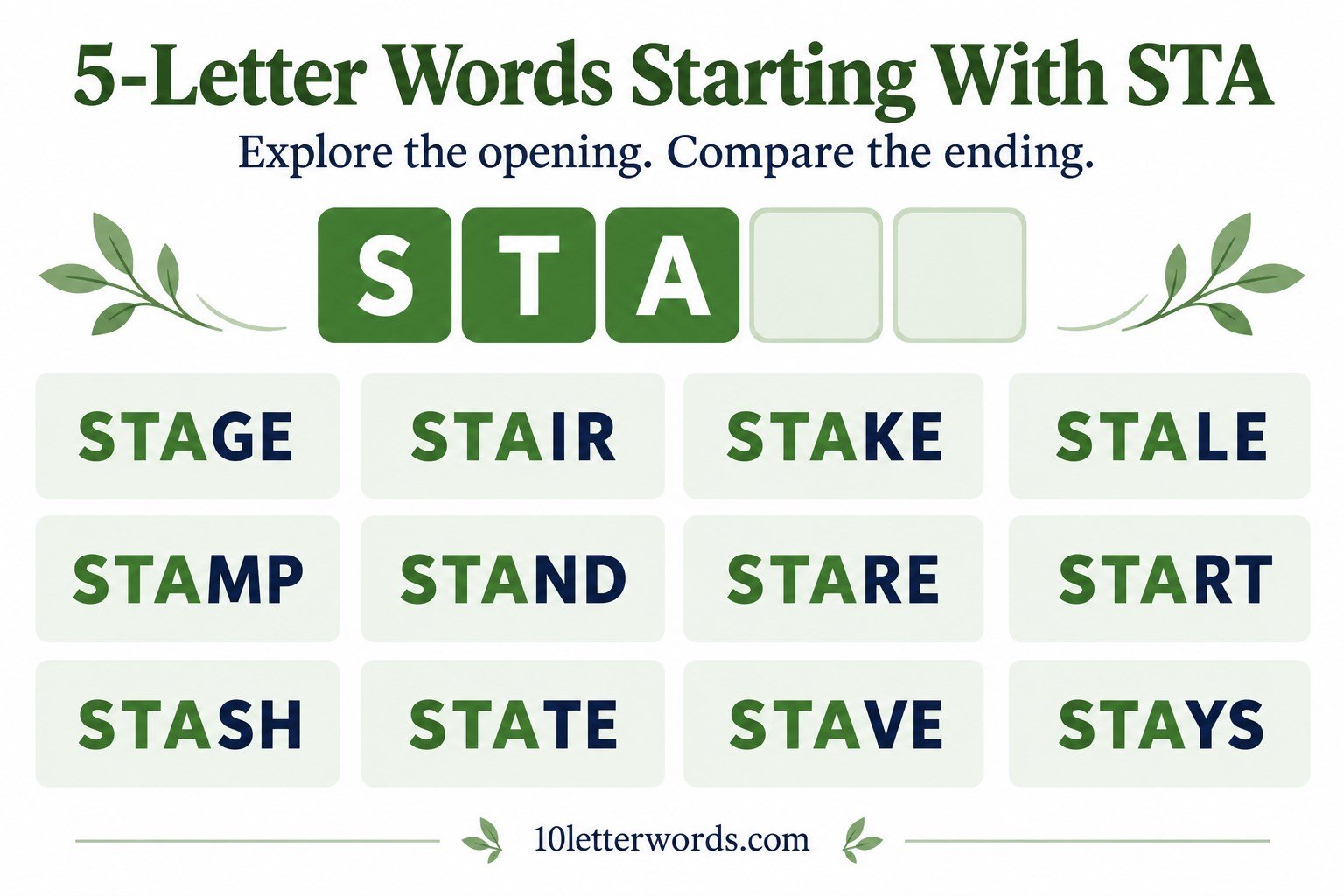
A useful study note pairs a spelling with a verified meaning and a short sentence. Avoid memorizing a rare reference form as an accepted game answer without checking the relevant lexicon first.
Understand What the Illustrated Tile Totals Show
The comparison below gives printed-letter base totals: STACK and STAFF each total 11, STAMP and STALK each total 9, STAGE totals 6 and STARE totals 5. For STAFF, S=1, T=1, A=1 and the two Fs contribute 8, giving 11.
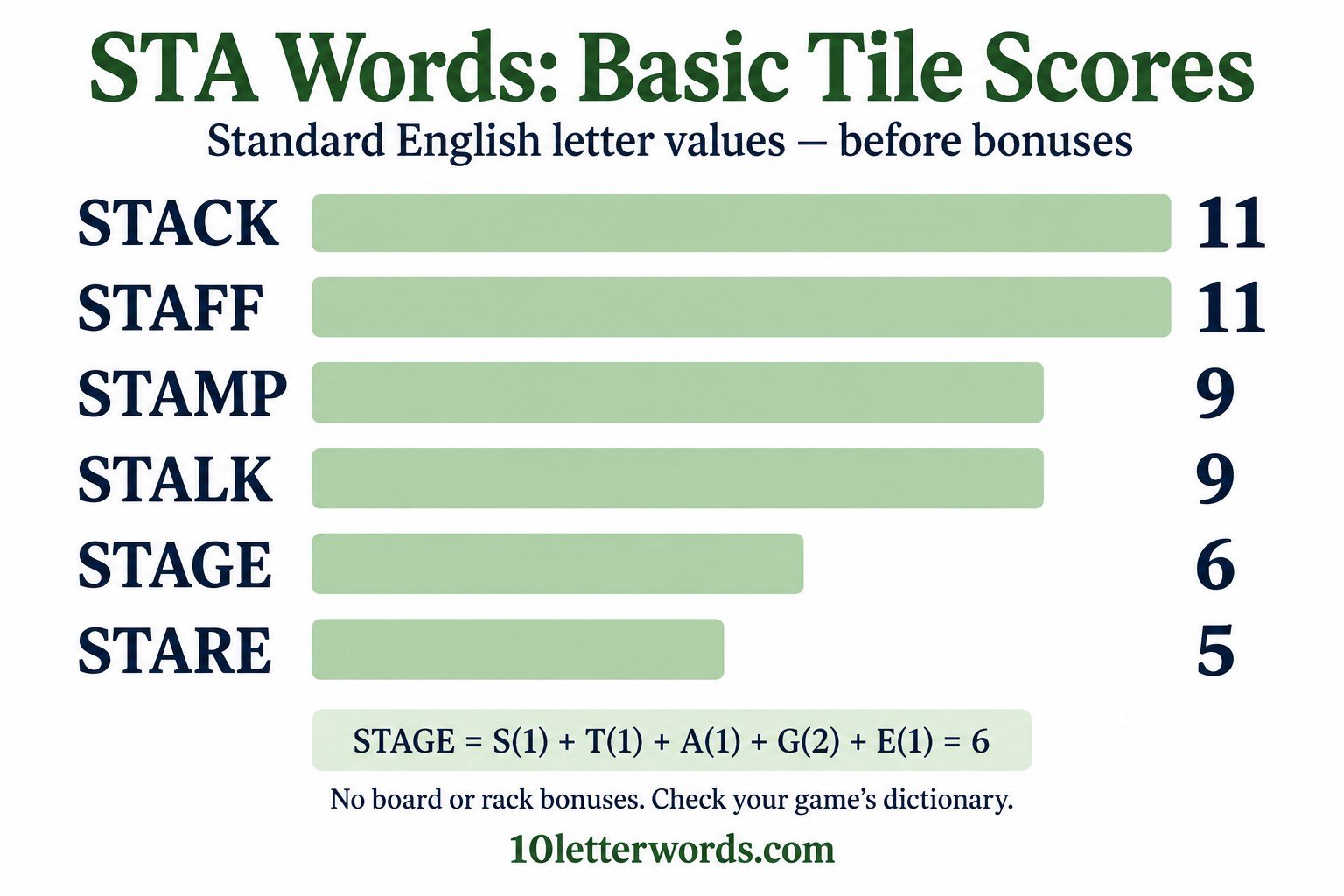
These are explanatory figures in the article. The filter itself does not calculate or sort scores. Blank substitutions, premium squares, other words formed by a move and bonuses require a separate calculation. Use the Scrabble Helper for rack searches within its input limits, and check the board separately.
Apply Filters Deliberately and Recognize the Reset State
Select Find Words or press Enter in any field to run the search. Editing a field alone does not refresh the tiles. With every field empty, Find Words displays all 44 entries; typing STA is optional because that opening is already fixed by the dataset.
Starts with can narrow further, as with STAN. All filled conditions apply together. A prefix incompatible with STA produces no matches, and an empty result does not trigger another dictionary download.
Clear empties fields and results, returning the initial instruction. Select Find Words again if you want the complete list. The tiles retain dataset order, with no score sort or pagination, and clicking a tile does not copy its text.
Move to a Related Reference When the Opening Changes
Use five-letter words beginning with S when TA is not confirmed. The Five-Letter Finder searches a separate general collection, whose coverage can differ. For rearranging supplied letters, use the Word Unscrambler. The Word Lists hub helps select another length.
Reference Limits and the Recorded Checks
On 23 October 2026, the 44 entries were checked for uniqueness, five A–Z letters and an STA opening. The E/AT example, FF sequence, STAN prefix, Enter search and Clear behavior were tested against the page's actual code. The illustrated base totals were recalculated.
Note on word lists: This is an independent spelling reference, not an official Wordle answer feed or certified Scrabble lexicon. Check the vocabulary and rules used by your game. The date records verification, not a dictionary revision or certification of every definition.
Questions About Five-Letter STA Searches
Why are eight results left when I choose ending E?
Eight entries in this collection have that ending. Add a confirmed adjacent sequence or use further crossings rather than assuming the first result is correct.
Does Contains TT find every entry with two Ts?
No. It requires adjacent Ts. STATE has separated Ts, so it does not match TT.
Do I have to fill Starts with?
No. The collection already fixes STA. That field is useful only when you know more of the beginning.
Why are scores shown in the article but not on result tiles?
The illustrations explain selected base totals. The interactive filter is a spelling search and has no scoring feature.
Will clicking a result copy it?
No. Select the text manually if you need to copy it.